The Business Case for Employee-Organization Relationships
High Quality Relationships.
Better Workforce Outcomes.
Organizations with stronger employee-organization relationships show higher satisfaction, greater commitment, and stronger retention.
The Evidence
As relationship quality declines, turnover risk rises.
The model was tested using a sample of 16,114 employees drawn from the 2024 Federal Employee Viewpoint Survey. Employees were grouped into strong, moderate, and weak EOR bands, then compared on intent to leave.
The pattern is clear. Intent to leave increased from 22% in the strongest relationship band to 64% in the weakest.
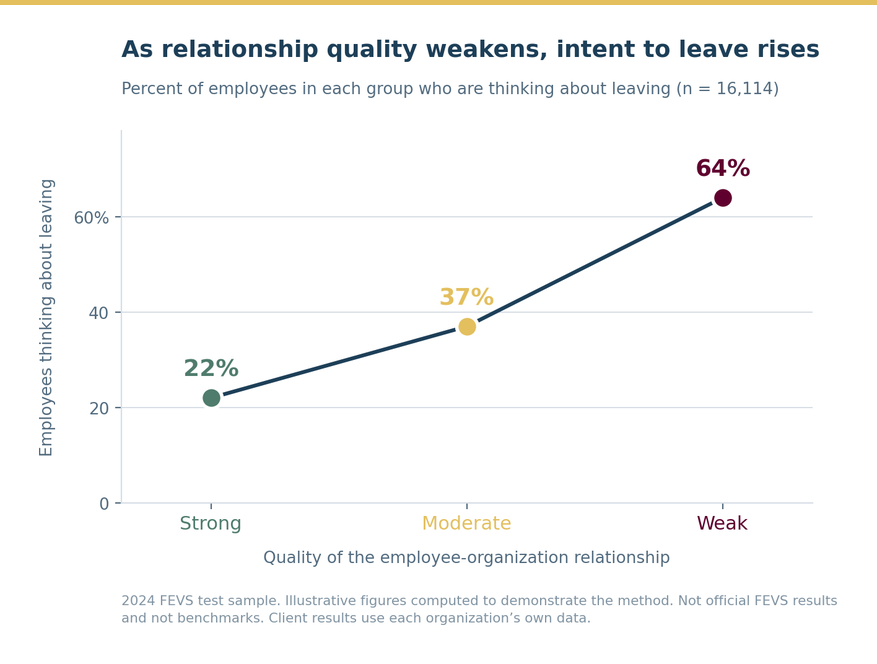
Employees with weak relationships had 3 times higher turnover risk.
3x
The Management Value
A survey rating answers half the question.
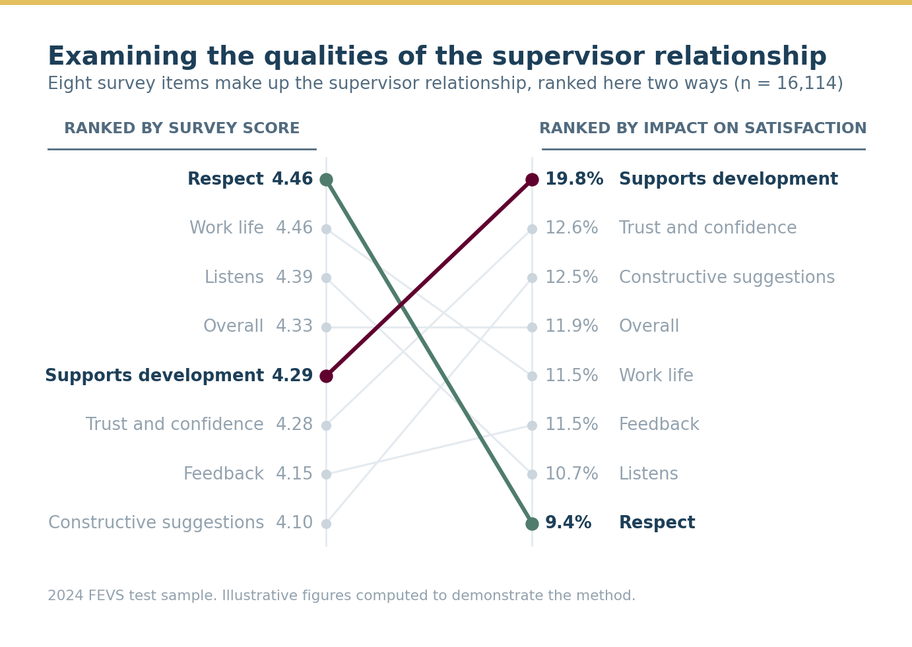
A five point scale tells you how employees rate each item. It cannot tell you which of those items is doing the most work. Ranking by rating produces a list where the strongest scores sit at the top, whether or not they are the items shaping the outcome.
Applying regression and decision tree analysis to the same responses adds the second reading: how much each item accounts for the outcome leadership is trying to improve.
An example, using the supervisor relationship.
Eight survey items make up the supervisor relationship.
The employees rate it well overall, with an index of 4.31.
Ranking those eight items by survey score and by impact on satisfaction produces two different orders.